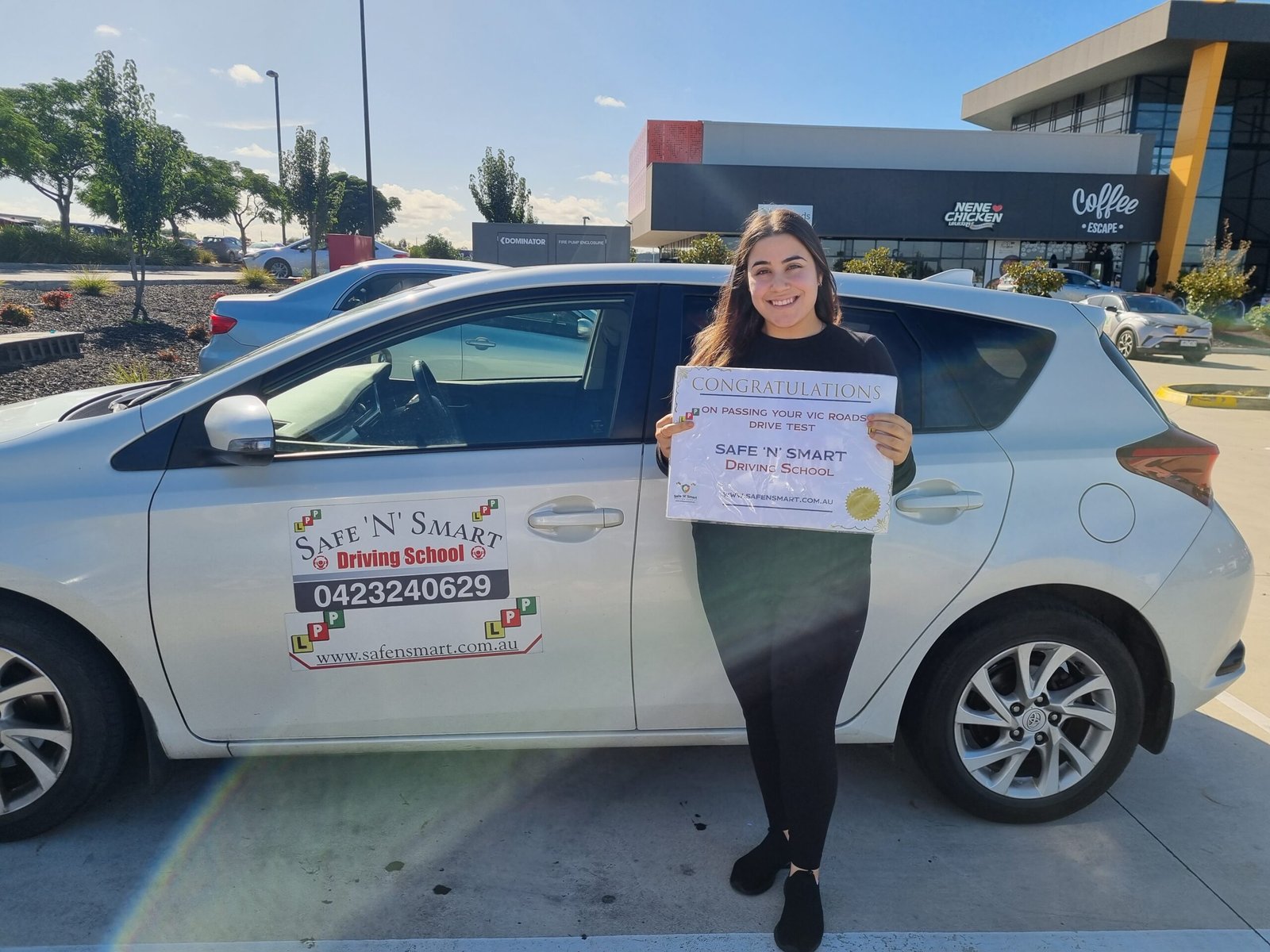
Safe N Smart Driving School | Driving Lessons Coolaroo & Melbourne’s Northern Suburbs
Passing your VicRoads Drive Test on your first attempt is an exciting milestone on your journey towards becoming a fully licensed driver in Victoria. However, for many learner drivers, the thought of taking the practical driving test can feel stressful and overwhelming.
Whether you’re preparing for your driving test in Coolaroo, Broadmeadows, Bundoora, or anywhere across Melbourne’s northern suburbs, proper preparation, safe driving habits, and confidence behind the wheel can make a significant difference.
Many learners wonder: How can I pass my VicRoads driving test the first time? What mistakes should I avoid? What does the driving examiner look for?
The good news is that passing your driving test isn’t about being a perfect driver. It’s about demonstrating that you can drive safely, independently, and confidently while following Victorian road rules.
At Safe N Smart Driving School, we understand the importance of developing strong driving skills before attempting your practical driving test.
In this comprehensive guide, we’ll share 25 practical tips to help you pass your VicRoads Drive Test on your first attempt, including expert advice on observation, speed management, parking, lane changes, road rules, and test-day preparation.
Understanding the VicRoads Driving Test in Victoria
Before exploring the 25 tips, it’s important to understand how the Victorian driving test works.
The VicRoads Drive Test includes a pre-drive safety check and two stages of on-road assessment.
| Test component | What to expect |
|---|---|
| Pre-drive safety check | Demonstrate knowledge of essential vehicle controls |
| Stage 1 | Approximately 10 minutes of driving in less challenging conditions, including a parking manoeuvre |
| Stage 2 | Approximately 20 minutes of driving in more complex traffic conditions |
| Test result | Feedback on your driving performance and whether you passed |
You must successfully complete Stage 1 before progressing to Stage 2. The examiner assesses observation, signalling, gap selection, speed choice, following distance, positioning, parking, and vehicle control.
25 Essential Tips to Pass Your VicRoads Drive Test on Your First Attempt
1. Take Professional Driving Lessons Before Your Test
One of the most effective ways to prepare for your VicRoads driving test is to take lessons with a qualified driving instructor.
Even if you’ve completed many hours of supervised driving with family or friends, a professional driving instructor can help identify mistakes you might not notice.
During professional driving lessons, you can improve your understanding of Victorian road rules, practise essential driving manoeuvres, and learn how to respond to different traffic situations.
An experienced driving instructor in Coolaroo can also help you develop safer observation habits, improve vehicle control, and prepare for the assessment process.
Expert tip: Book a driving assessment lesson before your test to identify the areas that require additional practice.
2. Understand the VicRoads Drive Test Assessment Criteria
Understanding what the examiner is looking for can help you prepare more effectively.
During your practical driving test, the examiner assesses your ability to drive safely and make appropriate decisions without assistance.
Important assessment areas include:
-
Observation and hazard awareness
-
Correct indicator use
-
Safe gap selection
-
Speed management
-
Following distance
-
Road positioning
-
Parking and vehicle control
Knowing these criteria allows you to focus on developing the skills that matter most.
Expert tip: Ask your instructor to explain how different driving mistakes are assessed and how to avoid critical and immediate termination errors.
3. Practise Regularly in Different Traffic Conditions
Driving confidently on quiet residential streets is important, but it isn’t enough to prepare you for every situation.
The VicRoads driving test may include busy roads, intersections, roundabouts, traffic lights, lane changes, and merging.
Practise driving in different environments, including residential areas, shopping precincts, multi-lane roads, and roads with varying speed limits.
Experience in different traffic conditions helps you improve your decision-making and hazard awareness.
Expert tip: Practise during different times of the day and in varying weather conditions when it is safe to do so.
4. Always Check Your Mirrors and Blind Spots
Failing to perform appropriate observation checks is a common mistake during driving tests.
Before changing lanes, merging, moving away from the kerb, or performing other manoeuvres, make sure you check your surroundings properly.
Your observation routine should include checking the relevant mirrors, using your indicators, checking blind spots where required, and ensuring it is safe before moving.

Expert tip: Make your head checks clear and deliberate while keeping your attention on the road. Avoid exaggerated movements that distract you from driving.
5. Follow Speed Limits Carefully
Speed management is one of the most important aspects of the VicRoads driving test.
Exceeding the speed limit by 5 km/h or more at any time, or exceeding it by any amount for five seconds or more, is listed as an immediate termination error. Any speeding in an active school speed-limit area can also result in immediate termination.
Always pay attention to speed-limit signs and adjust your speed appropriately.
Be particularly careful around school zones, roadworks, residential streets, and roads where speed limits change.
Expert tip: Check your speedometer regularly, especially after turning onto a new road or travelling downhill.
6. Avoid Driving Unnecessarily Slowly
Many learner drivers believe driving slowly will impress the examiner. However, driving significantly below the speed limit without a valid reason can be considered unsafe.
For example, travelling at 40 km/h in a 60 km/h zone when traffic and road conditions safely allow a higher speed may disrupt traffic flow.
The examiner wants to see that you can select an appropriate speed based on road conditions.
Expert tip: Drive at a safe, reasonable speed for the conditions rather than automatically travelling well below the speed limit.
7. Come to a Complete Stop at Stop Signs
Failing to stop properly at a Stop sign can lead to an unsuccessful driving test.
A rolling stop occurs when a driver slows down but never brings the vehicle to a complete stop.
When approaching a Stop sign, reduce your speed, stop completely at the required position, check for pedestrians and approaching vehicles, and proceed only when safe.
Expert tip: Make sure your wheels have stopped moving completely before proceeding.
8. Master Reverse Parallel Parking
Reverse parallel parking is one of the manoeuvres you may be asked to perform during Stage 1 of the VicRoads driving test.
Many learner drivers find this challenging because it requires accurate steering, observation, speed control, and awareness of surrounding vehicles.
Practise positioning your vehicle correctly, reversing slowly, checking for hazards, and finishing within an appropriate distance from the kerb.

Expert tip: Practise parking with different-sized spaces and vehicles rather than relying on one fixed reference point.
9. Practise Three-Point Turns
A three-point turn is another manoeuvre that may be included in Stage 1.
The purpose of this manoeuvre is to demonstrate your ability to turn your vehicle around safely in a limited space.
Before starting, check for approaching traffic, pedestrians, cyclists, and other hazards.
Move slowly and maintain control throughout the manoeuvre.
Expert tip: Prioritise safety and observation over completing the manoeuvre quickly.
10. Use Your Indicators Correctly
Indicators communicate your intentions to other road users.
Failing to signal, signalling too late, or giving a misleading signal can create confusion and increase the risk of a collision.
During your driving test, use indicators correctly when turning, changing lanes, moving away from the kerb, and performing other manoeuvres where signalling is required.
Remember that signalling does not automatically give you the right of way.
Expert tip: Develop a consistent habit of checking your surroundings, signalling appropriately, and confirming that it is safe before moving.
11. Maintain a Safe Following Distance
Following another vehicle too closely reduces your reaction time and increases the risk of a collision.
In good conditions, the three-second rule is a useful guide for maintaining a safe following distance.
Choose a fixed object beside the road. When the vehicle ahead passes it, count three seconds before your vehicle reaches the same point.
Increase the distance in wet weather, poor visibility, or other challenging conditions.
Expert tip: Avoid moving closer to the vehicle ahead simply because you feel pressured by traffic behind you.
12. Learn the Correct Give-Way Rules
Understanding give-way rules is essential for passing your driving test and becoming a safe driver.
You must know how to give way at intersections, roundabouts, pedestrian crossings, and when entering or leaving roads.
A common mistake is assuming that another vehicle will stop or slow down.
Always assess the situation carefully and give way whenever required by Victorian road rules.
Expert tip: Practise identifying who has priority at different intersections during your driving lessons.
13. Be Confident at Roundabouts
Roundabouts can be challenging for learner drivers, especially when traffic is busy.
As you approach a roundabout, reduce your speed, observe traffic, give way as required, and choose a safe opportunity to enter.
Pay attention to road markings and select the correct lane before entering a multi-lane roundabout.
Signal correctly when approaching and leaving the roundabout, as required by Victorian road rules.
Expert tip: Never rush into a roundabout because another driver behind you appears impatient.
14. Practise Safe Lane Changes
Lane changing is an important skill assessed during the VicRoads driving test.
Before changing lanes, check your mirrors, signal, check your blind spot, assess the available gap, and move smoothly when safe.
Avoid sudden steering movements or forcing another driver to brake.

Expert tip: Practise changing lanes in both light and moderate traffic until the observation and decision-making process becomes natural.
15. Maintain Correct Road Positioning
The examiner will assess how well you position your vehicle within your lane.
Driving too close to parked cars, drifting towards the centre line, or crossing lane markings unnecessarily can create safety risks.
Maintain a stable road position and allow adequate clearance from other vehicles, cyclists, and roadside hazards.
Expert tip: Look further ahead along the road instead of focusing only on the area immediately in front of your vehicle.
16. Watch Carefully for Pedestrians and Cyclists
Pedestrians and cyclists are vulnerable road users who require particular attention.
Be especially careful around shopping centres, school zones, pedestrian crossings, intersections, and residential streets.
Scan footpaths and roadside areas for people who may be preparing to cross.
When passing cyclists, follow Victorian minimum passing-distance requirements and allow additional space whenever necessary.
Expert tip: Slow down early when approaching areas with increased pedestrian activity.
17. Check Traffic Lights and Road Signs Early
Missing a traffic signal or road sign can result in a serious driving mistake.
Always scan ahead for traffic lights, Stop signs, Give Way signs, speed-limit changes, lane restrictions, and road markings.
Avoid making last-minute decisions because you noticed a sign too late.
Expert tip: When approaching an intersection, identify the traffic controls early and prepare to respond safely.
18. Learn How to Merge Safely
Merging requires good observation, speed control, and gap selection.
When approaching a merging area, check surrounding traffic, identify a safe gap, and adjust your speed smoothly.
Understand the difference between merging where a marked lane ends and changing lanes across a lane line, as the applicable give-way rules can differ.
Expert tip: Never assume another driver will create a gap for you. Make sure your movement is safe and complies with the road rules.
19. Stay Calm When You Make a Small Mistake
It is common for learner drivers to become nervous after making a minor mistake.
However, one small error does not necessarily mean you have failed your test.
If you make a mistake, stay focused, continue following road rules, and avoid trying to compensate through rushed decisions.
The examiner assesses your overall performance and whether your driving remains safe.
Expert tip: Concentrate on the next driving task instead of repeatedly thinking about a previous mistake.
20. Take a Mock VicRoads Driving Test
A mock driving test is one of the most useful ways to prepare for your actual assessment.
During a mock test, your driving instructor can simulate the testing environment by providing directions and assessing your driving without continuous coaching.
This helps you practise independent decision-making.
A mock test can identify weaknesses in parking, observation, lane changing, speed control, and hazard awareness.
Expert tip: Complete a mock driving test before your official appointment and allow enough time to practise any areas needing improvement.
21. Familiarise Yourself with the Driving Test Area
If you’re planning to take your driving test in Coolaroo or another Melbourne northern suburbs testing area, practising in the surrounding roads can help you feel more comfortable.
Become familiar with different types of intersections, speed-limit changes, roundabouts, pedestrian crossings, and lane configurations.
However, VicRoads test routes can vary, and no driving instructor can guarantee the exact route used on your test day.
Expert tip: Learn how to respond safely to different road situations rather than memorising a particular test route.
22. Know Your Vehicle’s Controls Before the Test
Before the on-road assessment begins, the examiner conducts a pre-drive safety check.
You may be required to identify or operate vehicle controls such as indicators, brake lights, headlights, horn, hazard lights, windscreen wipers, washers, and demisters.
You should also know how to identify the parking brake and start the engine safely.
Failure to demonstrate certain required controls, or faulty equipment, may prevent the driving test from proceeding.
Expert tip: Practise the pre-drive safety check in the exact vehicle you intend to use for your test.
23. Make Sure Your Test Vehicle Meets VicRoads Requirements
You can use your own car or an eligible driving instructor’s vehicle for your practical driving test.
However, the vehicle must meet the official requirements.
These include current registration, roadworthy condition, working lights, appropriate mirrors, seatbelts, a visible speedometer, L plates, and a suitable parking brake.
VicRoads does not provide a vehicle for your test.
Vehicles with electronic or foot-operated parking brakes cannot be used for solo tests under the published requirements; check the applicable rules for an eligible dual-control vehicle.
Expert tip: Check your vehicle several days before your appointment rather than discovering a problem on test day.
24. Get Enough Sleep and Arrive Early
Being tired, stressed, or rushed can affect your concentration and decision-making.
Try to get a good night’s sleep before your driving test.
Prepare your documents, confirm your appointment details, and plan your journey to the testing centre.
VicRoads recommends arriving approximately 15 minutes before your appointment.
Avoid excessive caffeine if it makes you feel anxious.
Expert tip: Allow enough time to settle in before your appointment so you can begin the test feeling focused.
25. Listen Carefully to the Examiner and Drive Independently
During the VicRoads driving test, the testing officer will provide directions such as turning left at the next street, changing lanes when safe, or pulling over at the kerb.
Listen carefully and follow instructions while maintaining safe driving practices.
If you do not understand an instruction, you can politely ask the examiner to repeat it.
Never make a sudden or unsafe manoeuvre just to follow a direction.
Expert tip: Remember that the examiner is assessing your ability to make safe driving decisions independently, not your ability to memorise directions.
Common Mistakes That Can Cause You to Fail Your VicRoads Driving Test
Even well-prepared learner drivers can fail because of serious safety-related mistakes.
The following errors deserve particular attention:
| Driving mistake | Possible test consequence |
|---|---|
| Driving through a red light | Immediate termination |
| Driving through a Stop sign | Immediate termination |
| Exceeding the speed limit by 5 km/h or more | Immediate termination |
| Exceeding the speed limit for five seconds or more | Immediate termination |
| Unsafe lane change requiring another driver to avoid a collision | Immediate termination |
| Mounting the kerb while driving | Immediate termination |
| Failing a required observation check without creating immediate danger | Critical error |
| Driving unnecessarily slowly | Critical error |
| Stalling a manual vehicle | Critical error |
| Rolling through a Stop sign without creating immediate danger | Critical error |
These classifications depend on the circumstances and the official assessment criteria.
How to Prepare During the Week Before Your VicRoads Driving Test
A structured preparation plan can help you build confidence and improve your performance.
| Day | Recommended preparation |
|---|---|
| Day 7 | Review Victorian road rules and driving test assessment criteria |
| Day 6 | Practise reverse parallel parking and three-point turns |
| Day 5 | Focus on intersections, roundabouts, and give-way rules |
| Day 4 | Practise lane changes, merging, and speed management |
| Day 3 | Complete a mock driving test with your instructor |
| Day 2 | Practise the areas identified for improvement |
| Day 1 | Check your vehicle and documents, and get adequate rest |
This schedule is a final preparation guide, not a substitute for sufficient supervised driving experience. If your mock test reveals significant safety concerns, consider postponing the official assessment until you are ready.
Frequently Asked Questions About Passing the VicRoads Driving Test
1. Is the VicRoads driving test difficult to pass?
The test can be challenging if you’re not fully prepared. However, learner drivers who understand road rules, demonstrate good observation skills, and practise consistently can improve their chances of passing.
2. How many mistakes are allowed in the VicRoads driving test?
There isn’t one simple allowance for every type of mistake. Under the published assessment criteria, no more than one critical error is permitted in Stage 1 and no more than two across the entire test. You must also meet the required assessment scores, and any immediate termination error results in failure.
3. How long does the VicRoads Drive Test take?
The on-road driving assessment generally takes approximately 30 minutes, with Stage 1 lasting around 10 minutes and Stage 2 approximately 20 minutes. Additional time is needed for the pre-drive check and administration.
4. Can I pass the VicRoads driving test without professional driving lessons?
Yes. Professional driving lessons are not compulsory for every applicant, provided they meet the relevant eligibility and supervised driving requirements. However, lessons with a qualified instructor can help identify weaknesses and improve test preparation.
5. Do I need to complete 120 hours of driving before my test?
If you’re under 21, you generally need at least 120 hours of supervised driving, including 20 hours at night, subject to applicable exemptions. Older learners have different requirements.
6. What happens if I fail my VicRoads driving test?
The testing officer will provide feedback on your performance. You can use this feedback to practise and improve before booking another test, subject to the applicable booking and eligibility requirements.
7. Can I use a driving instructor’s car for my VicRoads test?
Yes, provided the vehicle meets VicRoads requirements. Using a familiar vehicle may help you feel more comfortable during the assessment.
8. Can I ask the examiner to repeat an instruction?
Yes. If you don’t understand a direction, you can ask the testing officer to repeat or clarify it. This is preferable to making an unsafe last-minute decision.
9. What is the best way to prepare for a driving test in Coolaroo?
Practise different road conditions, complete mock driving tests, review the VicRoads assessment criteria, and work with a qualified driving instructor who can help you develop safe driving habits.
10. What is the most important tip for passing on the first attempt?
Focus on driving safely and independently. Good observation, correct speed management, safe gap selection, and calm decision-making are more important than trying to drive perfectly.
Why Choose Safe N Smart Driving School for Driving Lessons in Coolaroo?
Preparing for your VicRoads Drive Test becomes easier when you receive guidance suited to your driving experience and learning needs.
Safe N Smart Driving School is an option for learners looking for driving lessons in Coolaroo and Melbourne’s northern suburbs.
Professional driving instruction can help learners strengthen important skills such as road awareness, parking, observation, traffic navigation, and independent decision-making.
Whether you’re a beginner starting your driving journey, a learner preparing for your probationary licence, or someone who needs extra confidence before a driving test, structured driving lessons can support your progress.
Learners searching for Driving School Coolaroo, driving instructor Coolaroo, drive test Coolaroo, or driving lessons in Melbourne northern suburbs can contact Safe N Smart Driving School to enquire about lesson availability and driving test preparation services.
Final Thoughts: Pass Your VicRoads Driving Test with Confidence
Passing your VicRoads Drive Test on the first attempt is achievable with the right preparation, consistent practice, and a strong understanding of Victorian road rules.
The key is not to memorise a test route or drive perfectly. Instead, focus on developing safe driving habits that you can apply in real-world traffic situations.
By following these 25 expert driving test tips, practising regularly, and seeking professional guidance when needed, you can improve your confidence and readiness for your practical driving assessment.
Ready to prepare for your VicRoads Drive Test?
Contact Safe N Smart Driving School to enquire about driving lessons in Coolaroo and Melbourne’s northern suburbs. Build your confidence, improve your driving skills, and work towards passing your driving test on your first attempt.
Disclaimer: These tips are educational guidance and do not guarantee a pass. Driving test rules and requirements can change. Always refer to the latest official VicRoads and Transport Victoria information.